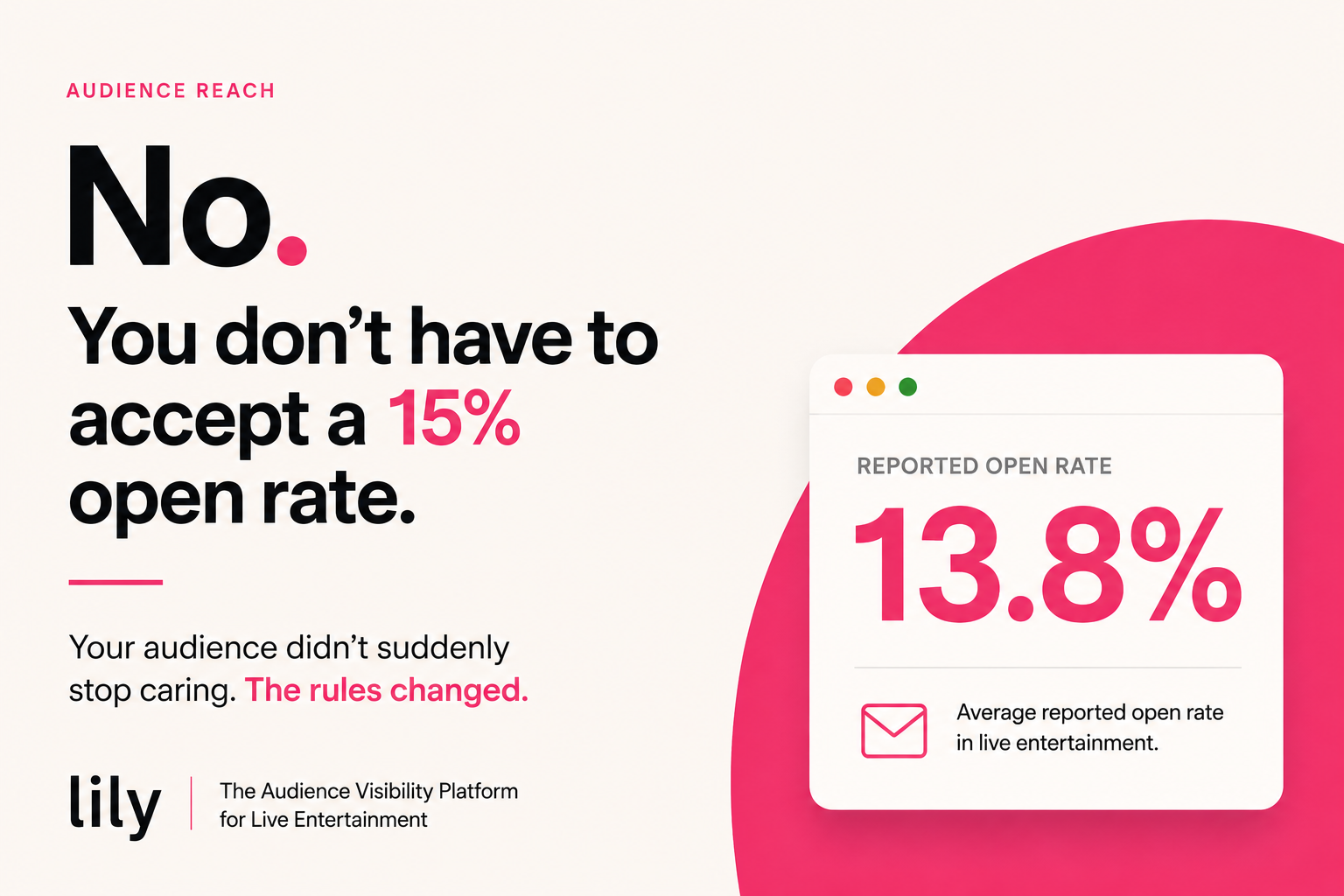

13.8%.
15%.
18%.
We keep seeing numbers like these.
For venues, festivals and live entertainment teams, a low email open rate can feel like a verdict. The audience has lost interest. The programme is not connecting. Email has stopped working.
But it does not automatically mean the audience stopped caring.
Content matters. So do the subject line, the timing and the offer. But audience reach is influenced by more than the message itself.
Sender reputation and authentication affect how mailbox providers assess your communication. Audience quality and permissions affect whether you are sending to people who genuinely want to hear from you. Relevance, segmentation, engagement and sending behaviour all shape the picture too.
There is rarely one simple explanation. That is why changing one headline, resending the same campaign or blaming the email platform can miss the point. A low open rate is a reason to investigate the system around the communication.
A large subscriber list can also create false confidence. Reach is not the number of addresses stored in a database. It depends on whether those addresses are current, permissioned, engaged and matched with communication that is relevant to them.
This matters especially in live entertainment. Audiences do not all want the same thing at the same time. A jazz subscriber, a family theatre visitor and someone who attended one conference are not one audience just because their email addresses sit in the same database.
Open rate remains a useful directional metric, but it is not a complete account of deliverability or readership. It is one signal that can tell you where to look more closely.
Reported open rate before and after moving communication to Lily.
These are reported open-rate results. They do not equal inbox placement or unique human readership, and they do not prove that one factor alone caused the change.
They do show that a low number does not have to be treated as permanent.
So what changed?
Reach is a system. It connects Data + Permission + Sender health + Engagement + Relevance. When those elements support each other, teams have a stronger foundation for useful, timely communication. When one or more are weak, even good content can struggle to reach and engage the people it was made for.
That broader view is part of Audience Visibility: understanding who the audience is, what they care about and whether your organisation can actually reach them.
If you're seeing open rates around 15%, don't simply accept the number. Investigate it.
The full guide explains what may be limiting reach, what to examine first and how to think about email performance without reducing it to one platform, one campaign or one metric.
